Why People Believe in Conspiracy Theories
B2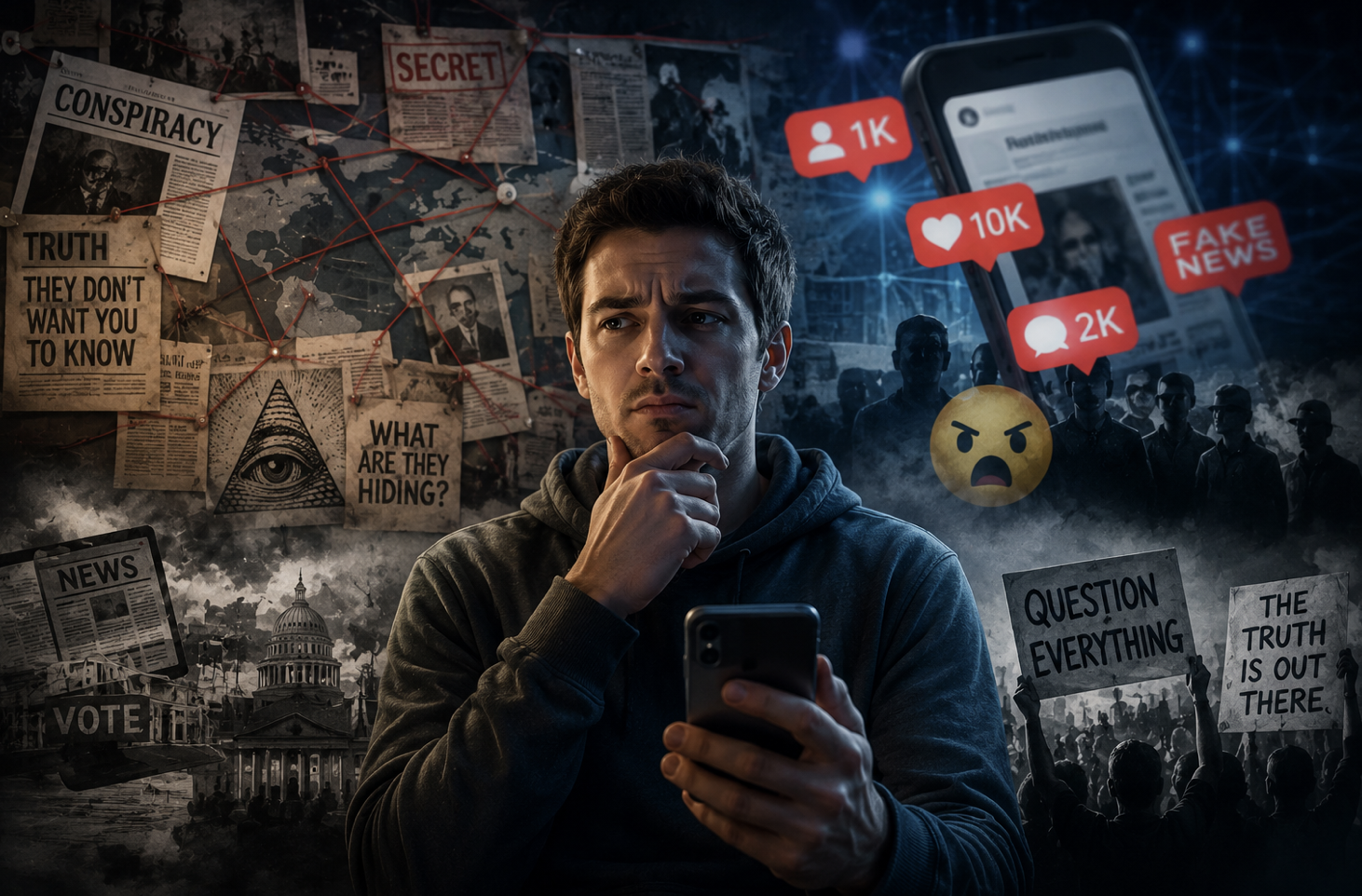
Conspiracy theories — the belief that powerful hidden groups are secretly controlling events for their own benefit — have existed throughout human history. What has changed dramatically in recent decades is the speed with which such theories spread and the scale of the audiences they can reach. Understanding why intelligent, educated people sometimes find these explanations compelling requires looking beyond simple assumptions about ignorance or irrationality.
One important factor is the human brain's tendency to search for patterns and causes, particularly in situations that feel threatening or confusing. When something significant and unexpected happens — an economic collapse, a pandemic, or the sudden death of a public figure — people naturally seek an explanation that matches the apparent scale of the event. A complex, carefully organised plot can feel more satisfying than the uncomfortable possibility that something devastating might have resulted from accident, coincidence, or simple human error. Psychologists refer to this as proportionality bias: the intuition that big events must have big causes.
A second factor is declining trust in established institutions. Surveys conducted across many countries consistently show that public confidence in governments, pharmaceutical companies, and mainstream media has fallen significantly over the past thirty years. When people no longer trust official explanations, alternative narratives — however poorly supported — can gain credibility by default. This is not entirely irrational: there have been genuine historical cases in which governments concealed important information from the public, which makes a degree of scepticism towards official accounts understandable, even if it can be taken too far.
The role of the internet and social media in amplifying conspiracy theories is difficult to overstate. Recommendation algorithms on major platforms are designed to maximise engagement, and content that provokes strong emotional reactions tends to be shared far more widely than calm, factual reporting. A sensational claim can reach millions of people within hours, while corrections and rebuttals often receive far less attention. Furthermore, online communities allow people who share a particular belief to find one another easily, reinforcing their views and providing a sense of belonging that can make those beliefs feel more certain.
Confirmation bias also plays a significant role. Once someone becomes convinced of a conspiracy theory, they tend to interpret new information in ways that support their existing belief, dismissing contradictory evidence as further proof that the truth is being hidden. This makes conspiracy theories particularly resistant to correction through straightforward fact-checking, since the act of being corrected can itself be incorporated into the theory as evidence of a cover-up.
Addressing the spread of conspiracy theories is therefore not simply a matter of providing better information, though accurate information certainly matters. It also requires rebuilding the institutional trust that many people have lost, improving media literacy so that individuals can evaluate sources more critically, and creating social environments in which changing one's mind is seen as a sign of intelligence rather than weakness.
Új szavak
- compelling – meggyőző, lenyűgöző
- proportionality bias – arányossági torzítás
- credibility – hitelesség
- rebuttal – cáfolat
- confirmation bias – megerősítési torzítás
- cover-up – leplezés, eltussolás
- 1
What does the text say has changed most significantly about conspiracy theories in recent decades?
- 2
What is 'proportionality bias' as described in the text?
- 3
Why does the text say it is not entirely irrational to distrust official explanations?
- 4
How do recommendation algorithms contribute to the spread of conspiracy theories?
- 5
Why are conspiracy theories particularly difficult to correct with facts?
- 6
According to the final paragraph, what is needed beyond simply providing accurate information?
- 7
What is the overall argument of the text about people who believe in conspiracy theories?