Albert Einstein's Strange Daily Habits
B2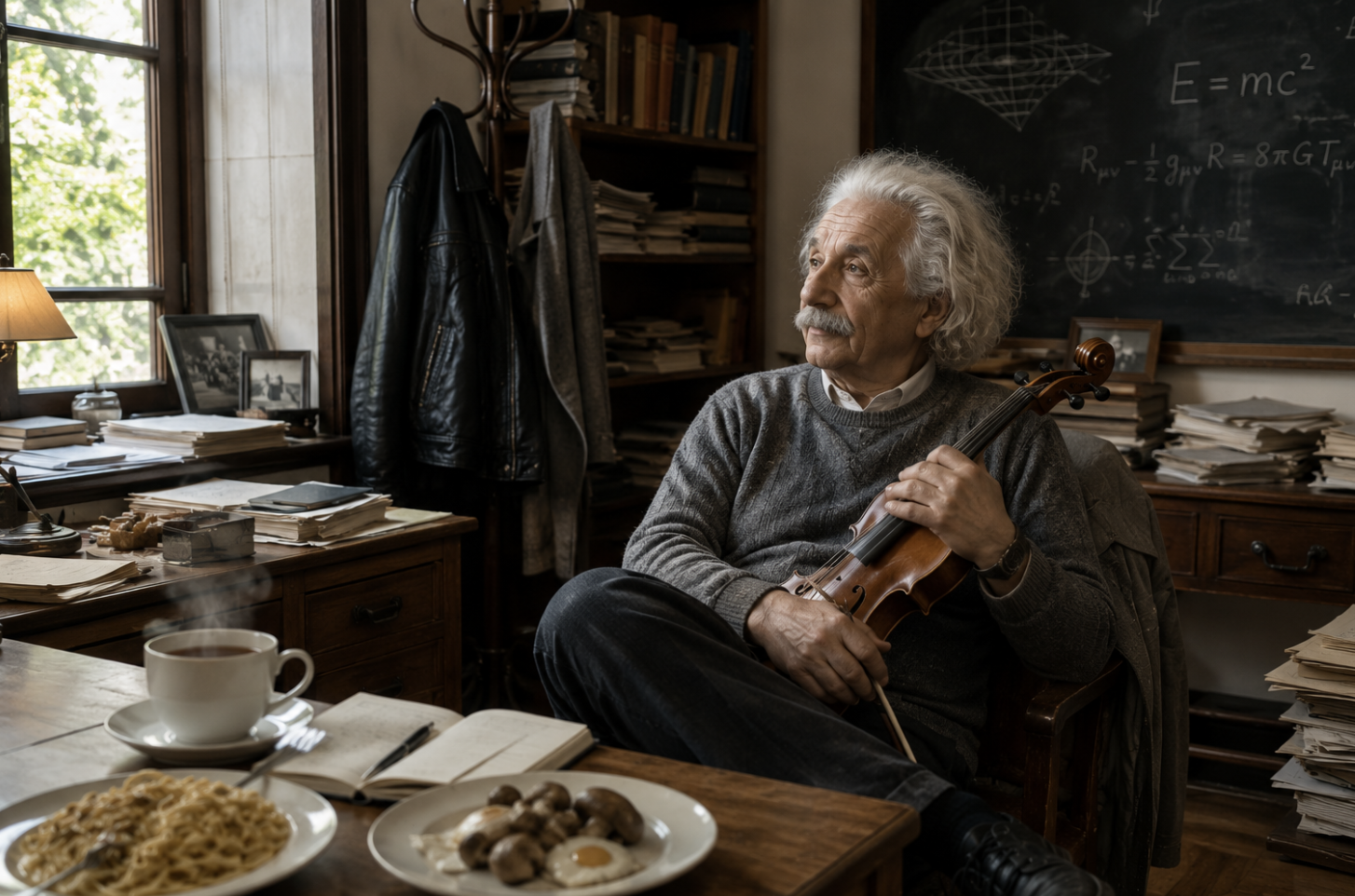
Albert Einstein is remembered above all as the physicist who transformed our understanding of space, time, and gravity. Yet alongside his scientific genius, Einstein was also known for a collection of personal habits and idiosyncrasies that struck many of those around him as eccentric, impractical, or simply baffling. Far from being trivial details, these habits offer a fascinating window into how one of history's most original minds approached everyday life.
One of the most frequently mentioned quirks concerns his attitude towards clothing. Einstein famously owned several versions of the same outfit — a grey suit, a leather jacket, or a simple sweater — and wore them on near-constant rotation. He found the daily ritual of choosing what to wear an unnecessary drain on his mental energy, and he saw no reason to invest time or thought in something he considered entirely unimportant. This approach, which some might dismiss as laziness, was in Einstein's view a rational strategy: by eliminating trivial decisions, he preserved his concentration for problems that actually mattered to him.
Sleep was another area where Einstein's habits diverged sharply from those of most people. He reportedly slept for around ten hours each night and was also in the habit of taking frequent short naps during the day, occasionally while sitting upright in a chair. He believed that adequate rest was not a luxury but an essential condition for creative thinking. According to those who knew him well, Einstein also used the period just before falling asleep as a kind of mental laboratory, deliberately turning over unresolved problems in his mind in the hope that solutions might emerge more freely in a semi-conscious state.
Einstein had a complicated relationship with food. He was not particularly interested in what he ate, often losing track of mealtimes entirely when absorbed in his work. Friends and colleagues described him as someone who ate whatever was placed in front of him without much comment or preference. However, he was genuinely fond of a few specific things: mushroom and egg dishes, spaghetti, and above all, a strong cup of tea. In his later years, Einstein also became a committed vegetarian, expressing the view that a plant-based diet was not only healthier but more consistent with a respectful attitude towards other living creatures.
Perhaps the most revealing of Einstein's habits was his practice of thinking in images rather than words or mathematical symbols. He described what he called "thought experiments" — vivid mental scenarios in which he would imagine, for instance, riding alongside a beam of light or falling freely through space. It was through these imaginative exercises, not through formal calculation alone, that he arrived at many of his most significant insights. Einstein himself acknowledged that his greatest strength was not rapid calculation or encyclopaedic knowledge, but an ability to hold a complex idea in his mind and examine it from multiple angles over an extended period of time.
Those who worked with Einstein in his later years at Princeton noted that he maintained an almost monastic simplicity in his daily routine. He walked to his office at the Institute for Advanced Study regardless of the weather, rarely accepted social invitations, and spent his evenings playing the violin, an activity he had practised since childhood and which he described as indispensable to his sense of wellbeing. In his own words, life was not worth living without music. Whether by instinct or deliberate design, Einstein had constructed a daily existence that minimised distraction and created the conditions in which his particular kind of thinking could flourish.
Új szavak
- idiosyncrasy – egyéni sajátosság, különleges szokás
- eccentric – különc, excentrikus
- quirk – furcsaság, szeszély
- monastic – szerzetesi, visszafogott, egyszerű
- indispensable – nélkülözhetetlen
- flourish – virágzik, kibontakozik
- 1
Why did Einstein wear the same type of outfit repeatedly?
- 2
What does the text say about Einstein's sleeping habits?
- 3
How did Einstein use the time just before falling asleep?
- 4
Which of the following best describes Einstein's relationship with food?
- 5
What were Einstein's 'thought experiments'?
- 6
What did Einstein consider his greatest intellectual strength?
- 7
What is the main point the author makes about Einstein's daily habits overall?